2026.09.8
What is a Flying Taxi? How aerpace is Pioneering India's Air Taxi Revolution
A flying taxi, or air taxi, is a small, on-demand aircraft built to carry passengers on short, point-to-point trips across a city.
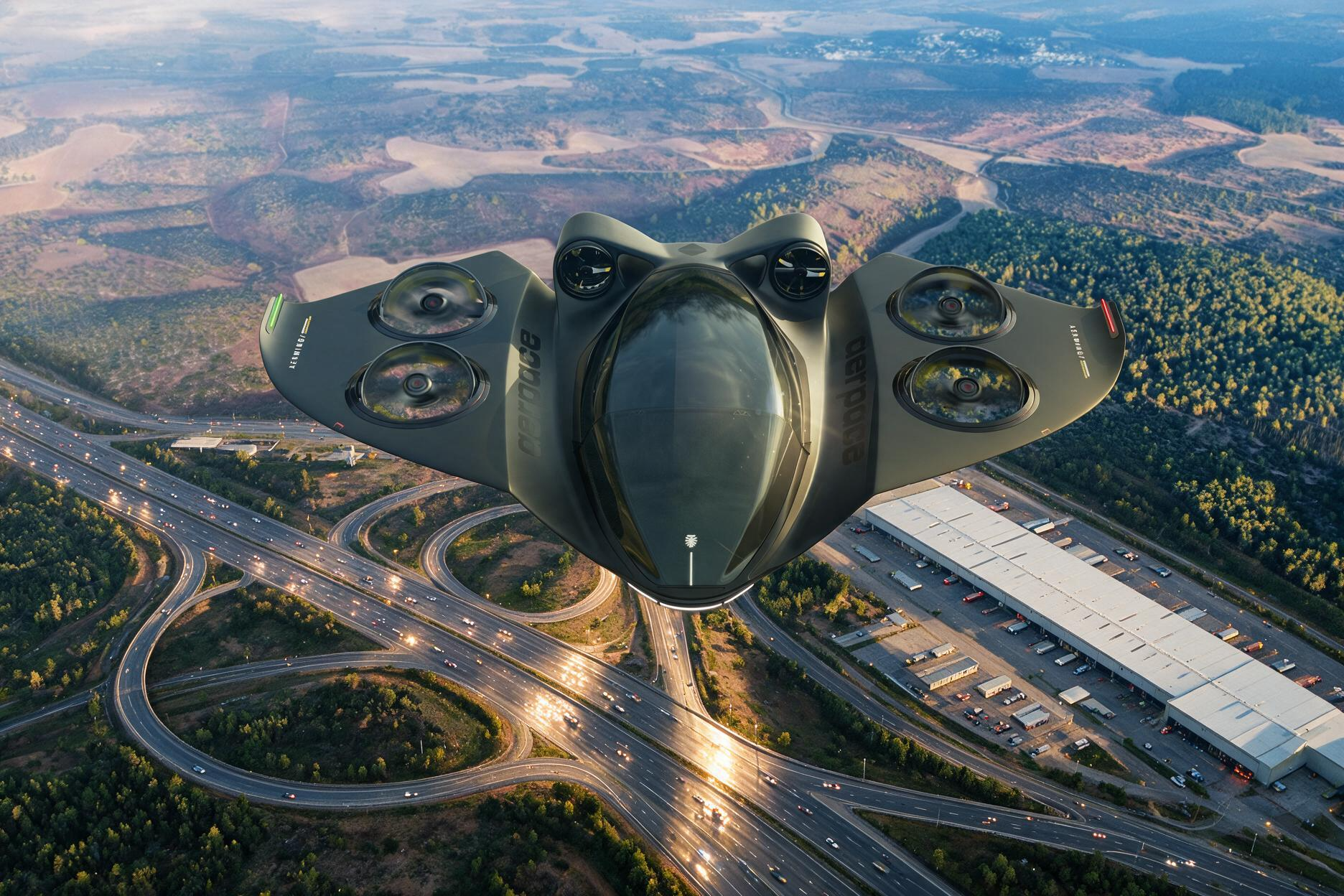
Most are eVTOLs: electric vertical take-off and landing aircraft that lift off without a runway, fly far quieter than helicopters, and produce zero tailpipe emissions. The two terms mean exactly the same thing.
Picture a Tuesday morning where your commute skips the bumper-to-bumper crawl entirely. You walk onto a rooftop pad, step into a quiet aircraft, and lift off above the skyline. Twelve minutes later, you're across town. In India, that reality is a few years away, and the groundwork is being laid right now.
As our cities run out of road, the next lane is opening above us. This is the rise of the flying taxi, and it's about to redefine how far ‘near’ and ‘far’ really are.
“With aerpace, the sky is no longer the limit. It's the new highway for India's future.”, said Ravi Soni, Executive Director, aerpace Industries Ltd.
What Is a Flying Taxi?
A flying taxi (also called an air taxi) is a small aircraft built for quick, point-to-point travel across a city. The modern flying taxi requires a vertiport, a compact landing pad on a rooftop, a parking structure, or beside an airport, rather than a conventional runway.
The technology powering this shift is the eVTOL. An eVTOL lifts straight up like a helicopter, then flies forward with the efficiency of a winged aircraft, running on batteries rather than jet fuel. The result: zero tailpipe emissions, a fraction of a helicopter's noise, and operating costs designed to reach roughly what a premium cab charges once fleets scale.
Three conditions must align for this to function as mass transit: the aircraft must be quiet enough to fly near residential areas, economical enough to run profitable routes, and capable of landing without a runway. eVTOLs are the first design to satisfy all three simultaneously. The payoff: a 40 km trip that consumes 90 minutes by road takes 12 to 18 minutes in the air.
How Does a Flying Taxi Work?
Three eVTOL designs dominate the market, each suited to a different kind of route:
Multirotor Multiple rotors lift and move it, like a large passenger drone Slower, shorter range (15–35 km) Short intra-city hops, dense city centres Lift + Cruise Separate rotors for hover, a fixed wing for cruising Faster, longer range Airport runs, city-to-city (e.g. Mumbai–Pune) Tilt-Rotor Rotors tilt forward to switch from hover to flight Fastest, 250–320 km/h Longer routes needing speed and flexibility
The shared engineering principle is redundancy. A flying taxi distributes its lift across many small motors and rotors rather than one large engine. So, the loss of a single rotor keeps the flight controlled and safe. That distributed design also accounts for the dramatically lower noise levels, and it's precisely why regulators treat eVTOLs as a serious aviation category.
aerpace and the Air Taxi India Movement
India is shaping up to be one of the largest flying taxi markets on earth, driven by arithmetic, not ambition. Our metros lose hours every day to congestion, and additional road infrastructure alone cannot resolve it. The only open direction is up.
aerpace is built for exactly that gap. The mission goes beyond designing an aircraft. aerpace is building the full ecosystem around it: the aerWing flying taxi, the aerDock vertiports it lands on, and the aerVolt clean energy that powers both. Indigenous engineering meets world-class aerospace design, with zero-emission propulsion built in from day one.
This is what #MAKETIME means in practice. Every kilometre flown faster, Cleaner, and better contributes to making time for the future. aerpace is building the next dimension of Indian travel.
Flying Taxis in India: A Movement Taking Off
The momentum behind flying taxis in India is real and well-funded. Major Indian industrial groups and global aircraft manufacturers are committing to eVTOL programmes. State governments are competing to host manufacturing. Central aviation authorities are drafting the airworthiness rules and vertiport standards that commercial service will operate under. Analysts size the global urban air mobility market in the trillions of dollars by 2040, with India projected to rank among the top markets by passenger volume.
The population is young, app-first, and ready. The congestion is chronic. The technology is here.
The winners in this space will be those who build the whole system, aircraft, vertiports, and clean power, so the network functions at city scale. That is the bet aerpace is making.
The Sky Is the New Highway
The arrival of flying taxis in India signals a fundamental shift in what distance means. A two-hour drive becomes a ten-minute flight. A city stops being defined by how far people can stand to commute. Time, the one resource none of us can manufacture, gets handed back.
aerpace is building toward a democratic sky, where the future of travel belongs to everyone. When the world looks up to see what comes next in transport, an Indian flying taxi will be leading the way.
Let's fly into tomorrow, together.
frequently asked question
What is an electric air taxi?
An electric air taxi is a battery-powered eVTOL aircraft built for short, sustainable city travel. It takes off and lands vertically, flies cleaner and far quieter than a helicopter, and produces zero tailpipe emissions. aerpace is building a full flying taxi ecosystem in India, aerWing (aircraft), aerDock (vertiports), and aerVolt (solar energy), to move people over traffic, above it.
Is a flying taxi the same as an air taxi?
Yes. ‘Flying taxi’ and ‘air taxi’ are two names for the same thing: a small, on-demand aircraft for short city trips. Today, both terms refer to eVTOLs.
When will flying taxis launch in India?
Operators are targeting first limited service routes around 2028–2029, subject to DGCA certification and vertiport readiness.
Are flying taxis safe?
Flying taxis are engineered with multiple redundant rotors, batteries, and flight computers, ensuring a single failure still allows controlled flight. They must clear DGCA type certification, on par in rigour with commercial aircraft standards.
Will flying taxis be autonomous?
Early Indian flights will be piloted. Fully autonomous operation is a longer-term goal, requiring new licensing frameworks and regulatory development.
What is aerpace building?
aerpace is building an end-to-end flying taxi ecosystem in India, the aircraft, the vertiports it lands on, and the clean energy that powers them, under its #MAKETIME philosophy of giving people their time back.